How to evaluate detergent performance
Foam appearance alone does not measure cleaning power; testing should match real use.
Read article
Powder performance depends on particle distribution, dissolution, moisture and the surfactant system.
← Back to insights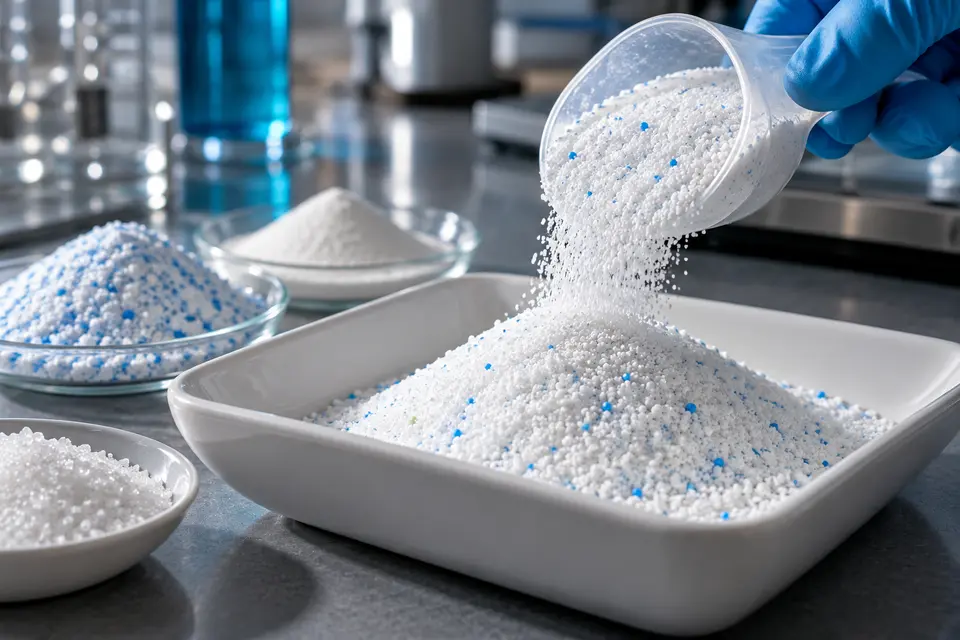
Powder performance depends on particle distribution, dissolution, moisture and the surfactant system.
Laundry powder can combine surfactants, water-hardness control ingredients and flow aids depending on product design. Granule size and distribution affect dissolution and movement through filling equipment. Moisture exposure can cause caking, inconsistent dosing and a poor wash experience. Powder color or fragrance alone cannot demonstrate stain-removal ability.
Run trials on representative stains and textiles while controlling wash cycle, dose, water temperature and hardness. Inspect remaining particles and fabric appearance after the wash. Separately examine powder flow and caking after storage in the intended pack. Removing one laboratory stain does not establish that the powder will work consistently in a machine or on the shelf.
For two candidate laundry powders, record granule condition and flow immediately after production. Store packed samples under relevant humidity conditions and inspect for caking. In washing trials, use matched stained textiles at the same detergent dose, cycle and water temperature, checking both stain removal and undissolved residue. If a problem appears, investigate moisture, particle size and powder addition before concluding that the surfactant concentration is too low.
Monitor flow and caking in storage.
Test dissolution across water temperatures.
Distinguish lab results from washing-machine performance.
References for general scientific principles; they do not imply MS CHEM has performed tests or holds certifications.
 MS CHEM / 01
Foam appearance alone does not measure cleaning power; testing should match real use.
Read article MS CHEM / 03
Fragrance is part of product experience but must work with the cleaning base and pack.
Read article MS CHEM / 04
Aim for quick cleaning and minimal visible residue while considering surrounding materials.
Read article