How to evaluate detergent performance
Foam appearance alone does not measure cleaning power; testing should match real use.
Read article
Aim for quick cleaning and minimal visible residue while considering surrounding materials.
← Back to insights
Aim for quick cleaning and minimal visible residue while considering surrounding materials.
Glass may look clean while wet and show streaks when water evaporates. Performance depends on wetting, lifting fingerprints or dust and wiping away liquid without visible nonvolatile residue. Drying speed, cloth choice and water quality affect results; evaporation that is too fast may leave insufficient wiping time. Clarity inside the bottle is therefore not enough.
Prepare similar glass panels with matched fingerprints and use controlled cleaner volumes and wiping strokes. Inspect fully dry panels under angled light. Check nearby frames, seals and coatings because spray does not touch glass alone. Evaluate ventilation and safety instructions against actual ingredients, and never encourage mixing unrelated cleaning chemicals.
Prepare equivalent glass panels with comparable fingerprints and dust. Apply equal cleaner volumes and have one operator use the same cloth and number of strokes. Inspect the panels when dry under normal and angled light, then test relevant nearby trim or coated surfaces for compatibility. This separates sprayer convenience, actual soil removal and post-evaporation streaking—three different aspects of performance.
Assess streaking under different lighting.
Balance drying speed with wipeability.
Check compatibility with frames and coatings.
References for general scientific principles; they do not imply MS CHEM has performed tests or holds certifications.
 MS CHEM / 01
Foam appearance alone does not measure cleaning power; testing should match real use.
Read article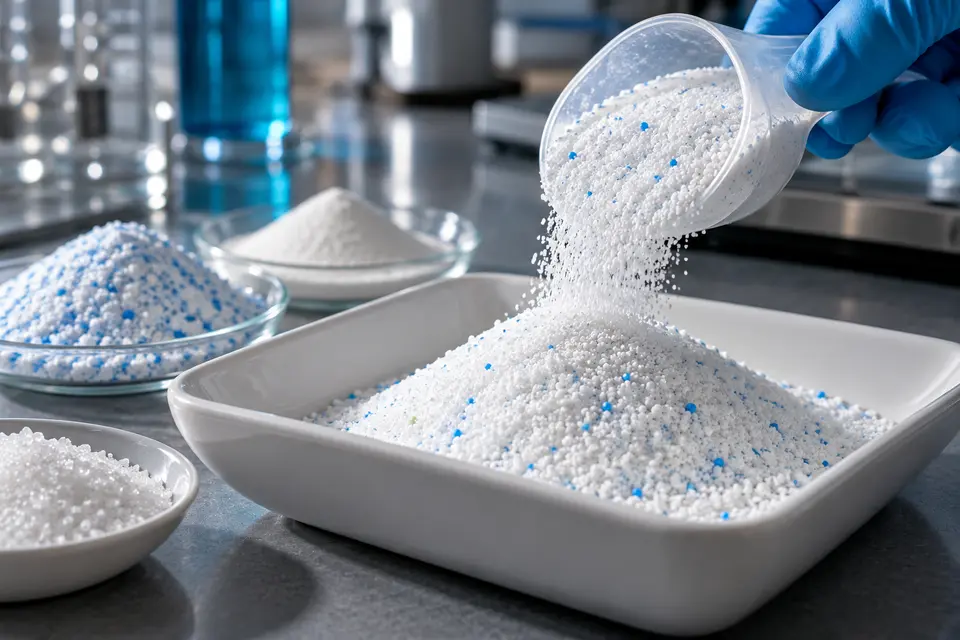 MS CHEM / 02
Powder performance depends on particle distribution, dissolution, moisture and the surfactant system.
Read article MS CHEM / 03
Fragrance is part of product experience but must work with the cleaning base and pack.
Read article