How surfactants work
Surfactants assist wetting and soil removal, but selection depends on the whole system.
Read article
Amphoterics can modify foam and feel within suitable systems.
← Back to insights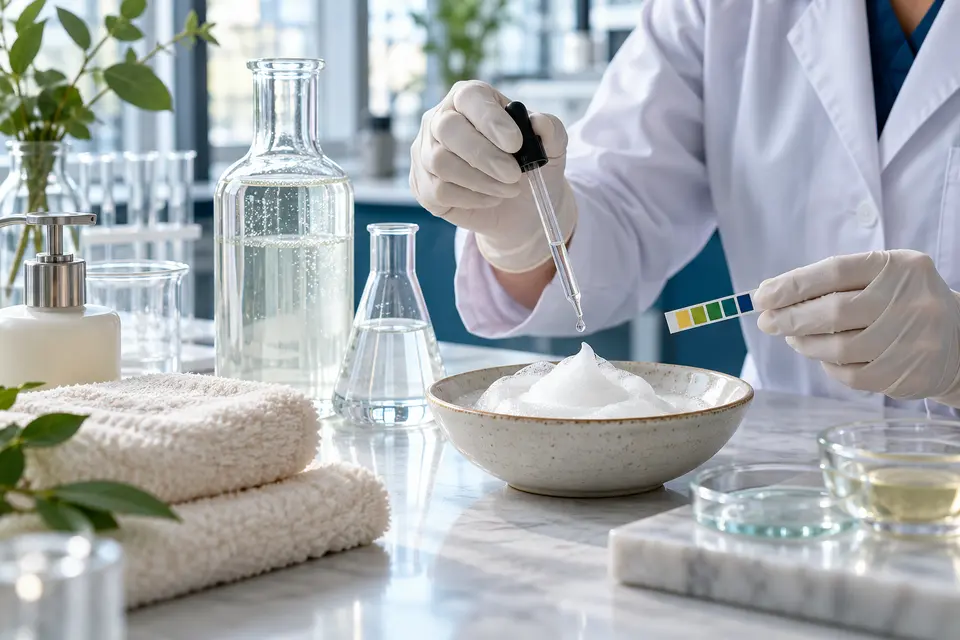
Amphoterics can modify foam and feel within suitable systems.
Amphoteric surfactants include substances whose charge state or interactions can change with pH. Selected grades are used in hair wash, hand wash and liquid cleaners to tune foam, texture or viscosity. Benefits are not universal across grades; they depend on partner ingredients, electrolytes, concentration and actual pH conditions.
Make controlled samples at different amphoteric levels with the rest of the formula fixed. Measure viscosity, clarity, foam and rinsing under defined conditions and after storage; test promising options in the intended packaging. The thickest sample may dispense poorly, so selection should follow overall use, safety and cost.
Prepare a hand-wash sample series with graduated amphoteric levels while holding other ingredients constant. Compare viscosity, foam and clarity at relevant temperature and pH, then repeat after storage. Test the best candidates in the intended pump or cap because greater thickness may impair dispensing. This distinguishes a real functional benefit from a change that merely looks attractive in a laboratory sample.
Review the effect of pH on behavior.
Use real compatibility tests.
Assess performance cost in the entire formula.
References for general scientific principles; they do not imply MS CHEM has performed tests or holds certifications.
 MS CHEM / 10
Surfactants assist wetting and soil removal, but selection depends on the whole system.
Read article MS CHEM / 11
Anionic systems are common in cleaning, while compatibility still needs evaluation.
Read article MS CHEM / 12
Nonionics offer options for wetting and removal of particular soils.
Read article